
Exemplars: Unlocking Writing, Unlocking Teaching

When I was a senior in high school, a family friend gave me a copy of an essay that her son had written. He was an English major in college; his essay had earned an A. The essay was short, just a page and a half double spaced, but it changed the way I write. I don’t remember the essay’s topic, but I remember being struck by both the sophistication of the analysis and also by its casual tone. I had only experienced academic writing as stiff or stilted. This writing was relaxed and even a bit playful. It felt like only that student could have written that essay. It inspired me. Through the remainder of high school and all through college, I kept that essay in the top drawer of my desk. Whenever I felt stuck, I would get it out and reread it. The essay became a touchstone for me, and it helped me analyze more deeply and write with stronger voice. This essay unlocked better writing that was inside me. This is the power of an exemplar.
An exemplar is not perfection. Rather, it is an example of what strong writing looks like.
In my own career as a student, exemplars were few and far between. As a teacher, exemplars are my cornerstone.
I always write an exemplar
Whenever I share a student exemplar with my class, the author lights up and the rest of the class sits a little taller and leans in a little closer. Look what Olivia can do! Look what choices Gene made. Let’s learn from them! Student exemplars are important, and they dominate the writing that I share in my class. And, my teacher exemplars remain essential.
When I sit down to write an exemplar, I do so as my best writing self. I do not pretend to be a seventh grader or an eighth grader. The text and the prompt create the grade-level parameters; they set the rigor. The skill of the writer does not change the rigor of the task. If I write as a hypothetical student, then the tone of my writing becomes false or mechanical. When I write as my best writing self, I create writing that is authentic and worth learning from.
I experience several benefits to writing my own exemplar:
I test the task
My best self knows that it is important to write exemplars. However, my busy self sometimes eschews this step. I’ve done it. I’m sure you’ve done it. And then I put a task in front of students and when we’re in the middle of class, I realize the task is confusing or simply doesn’t work. I have put a compare and contrast prompt in front of students and frankly there was nothing meaningful to contrast. If I had written an exemplar, I would have seen that problem and adjusted the prompt, passages, or both.
I gain a realistic sense of time
Time is wibbly wobbly and it is easy to underestimate or overestimate how long something takes. Underestimating creates unnecessary stress for an entire class. Overestimating means squandering time, creating lost opportunities for meaningful learning experiences. When I create an exemplar, I time myself. I then double the time and provide my students with that time. I’m deeply familiar with my content and I’m a fast reader and writer. I’ve found the 1:2 conversion rate is appropriate for my class. Others might find 1:1.5 conversion rate is appropriate or maybe you’re super speedy and a 1:3 conversion rate is reasonable. I tell students where my time stamps come from. They appreciate that I expect them to operate with swift urgency but not with a panicked rush. Students have told me that I am, “Consistently reasonable,” and that feels like high praise from 13-year-olds.
I gain students’ respect
My students know that for every essay they write, I have written it as well. I am not above the task I am putting in front of students. This alone goes a long way. However, they also get to read my writing. I have found that many students’ hearts and minds open up to me when they see what I can do.
Writing exemplars unearths the secret codes of writing
When I write an exemplar, I experience the entire writing process. Last year, when preparing to write an exemplar for an example state test essay, I had to pause my background music while reading the passage. I had to go back and reread. “Wait. Which character is that?” I found myself thinking. “Was the mom talking to her son or her dog?” The dog was characterized so lovingly as a family member that it was not immediately clear which characters were human and which were not. By fully engaging with the task, I had unearthed some text complexity. I became aware that simply naming the characters would likely be a challenge for my students because it had been for me. I chose to ask a check-for-understanding question that would force students to properly identify all characters. If I had not written the exemplar and had just put the practice in front of my students, I likely would not have noticed that names were a source of text complexity. As a teacher I often try to guess what will be challenging for my students, but nothing does this better than completing the task myself and noticing what gives me pause or is tricky.
As I engage in the writing process, I get to notice my own cognitive process: what notes are useful for me, when do I need to return to the texts or prompt, when do I reread what I had previously written? These experiences are the secret code to writing. When I write an exemplar, I have the opportunity to notice the code and then help students crack that code through direct instruction, shared writing, and independent practice.
I unlock patterns of writing and thinking
While writing an exemplar, I chose to use the word “ergo” after a particularly poignant point. Frankly, until I was actually writing, I had forgotten about the word “ergo.” Because I was writing, I remembered the word and chose to introduce it to my students. We talked about how “ergo” is a once-per-essay kind of word and how it needs to be strategically placed. Students often feel proud when they properly use this word.
I, like many English teachers, have struggled to get students to actually analyze text evidence, rather than restate the quotes or their claims. In a moment of desperation, I turned to several of the exemplars I had written over the years and mined them for analysis. For example, I saw that instead of analyzing what happened in a particular quote, I discussed what it would have meant if the opposite had occurred. I then explained what it meant that the opposite had not occurred. This is how I discovered my favorite analysis strategy: explore the opposite. I then compiled the analysis strategies into a student resource and have taught them how to apply these strategies in their own writing. Students have started mixing and matching analysis strategies to make their points in ways that are fresh and nuanced. Table 1 includes a 7th grade example of this analysis. After the quote, the student used the strategy “Discuss Evidence Type”, which I bolded, as well as “Explore the Opposite, which I underlined.
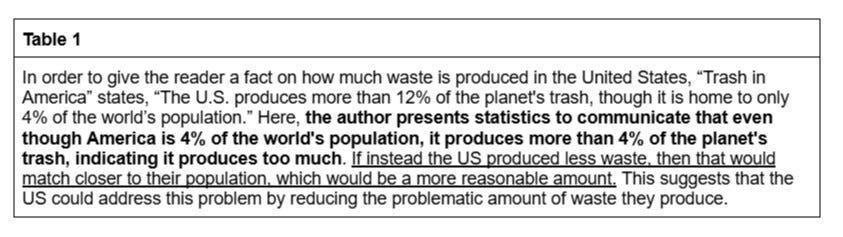
When my instruction feels stale or I feel like I’m out of tricks, I reread my exemplars or write a new exemplar. I always discover a new element of craft to share with my students.
I know that this week will be too busy (as will the week after that). I’ll feel the itch to skip the exemplar. My inner voice will rationalize: “You’re a pro! You can skip this one.” But, I know I’ll write it. And, as soon as I start, I’ll be glad that I did. Nearly 20 years ago, a 500-word exemplar unlocked my own writing. During my teaching career, exemplars continue to unlock my best teaching.
I’m so obsessed with exemplars
What comes through so clearly is that exemplars aren’t just a student support; they’re a form of professional thinking for the teacher. Writing the task yourself is less about modelling polish and more about surfacing the invisible decisions, hesitations, and strategies that experienced writers use without realising. That’s where the real instructional power sits.
I especially appreciate the insistence on writing as your best writing self. It reframes exemplars away from “teacher pretending to be a student” and toward something far more honest: this is what the work looks like when the thinking is clear. The point about rigor living in the task, not in artificially constraining the writer, feels important here. Students don’t need watered-down models; they need to see what’s possible and then be taught how to move towards it.